


Everything you own will be moving onchain, and here’s what’s happening behind the scenes.
Only a few years ago, NFTs were all over the headlines; then came along stablecoins, memecoins, and now Real-World Assets (RWAs).
Tokenization is shaping up more quickly than we can imagine. Now anyone, from anywhere in the world, can get a slice of tokenized US stocks, treasury funds, or even a stake in a pre-IPO market.
Everyone believed in the technology. BlackRock’s Larry Fink spoke it into existence, saying, “Every asset can be tokenized” - BlackRock’s 2025 Chairman’s Letter to Investors.
Since then, Real World Assets have grown exponentially, rising to $36.9B in distributed value across the DeFi space.
So where is tokenization headed? Are institutions truly embracing it, and which projects are leading the way? Let's explore these questions and what they mean for the future of finance.
What are Real World Assets (RWAs) & Tokenization?
In the simplest terms: Real World Assets are blockchain-based representations of assets that exist outside of crypto.
Think of them like stocks, commodities, ETFs, bonds, private credit, real estate, and treasury bills.
Now, that token can almost represent anything we want it to be.
The first successful real-world asset onchain wasn't a stock or a bond; it was the US dollar. Fiat-backed stablecoins like USDT and USDC proved that real-world assets could be tokenized, transferred globally, and settled 24/7 on blockchain networks.
That success laid the foundation for today's wave of tokenized Treasuries, private credit, stocks, and other real-world assets.
Traders often end up thinking, why should we pay attention to Real World Assets?
The answer is simple: RWAs bridge two of the world's largest financial ecosystems together: Traditional Finance (TradFi) and Decentralized Finance (DeFi).
More specifically, it combines the yield and stability characteristics of traditional finance with the programmability, transparency, and 24/7 accessibility of DeFi.
Rather than opening accounts with multiple brokers, traders can access these markets through a familiar DeFi experience.
A recent example is the historic SpaceX IPO, where multiple tokenization platforms, including Ondo Finance, SynFutures, Dinari, and xStocks, brought one of the world's most anticipated public listings onchain, giving global investors faster and more accessible exposure from day one.
A New Financial Era is Underway
Finance is entering a new era as more real-world assets move onchain.
This is shaping DeFi in every sector. Instead of relying entirely on traditional financial infrastructure, assets are increasingly being represented as digital tokens on blockchain networks, making them easier to access, transfer, and manage.
This shift is not about replacing existing markets. It is about making them faster, more efficient, and more accessible to investors around the world.
The three largest tokenized asset categories are stablecoins, United States Treasuries, and private credit, with tokenized stocks quickly emerging as the next major growth area.
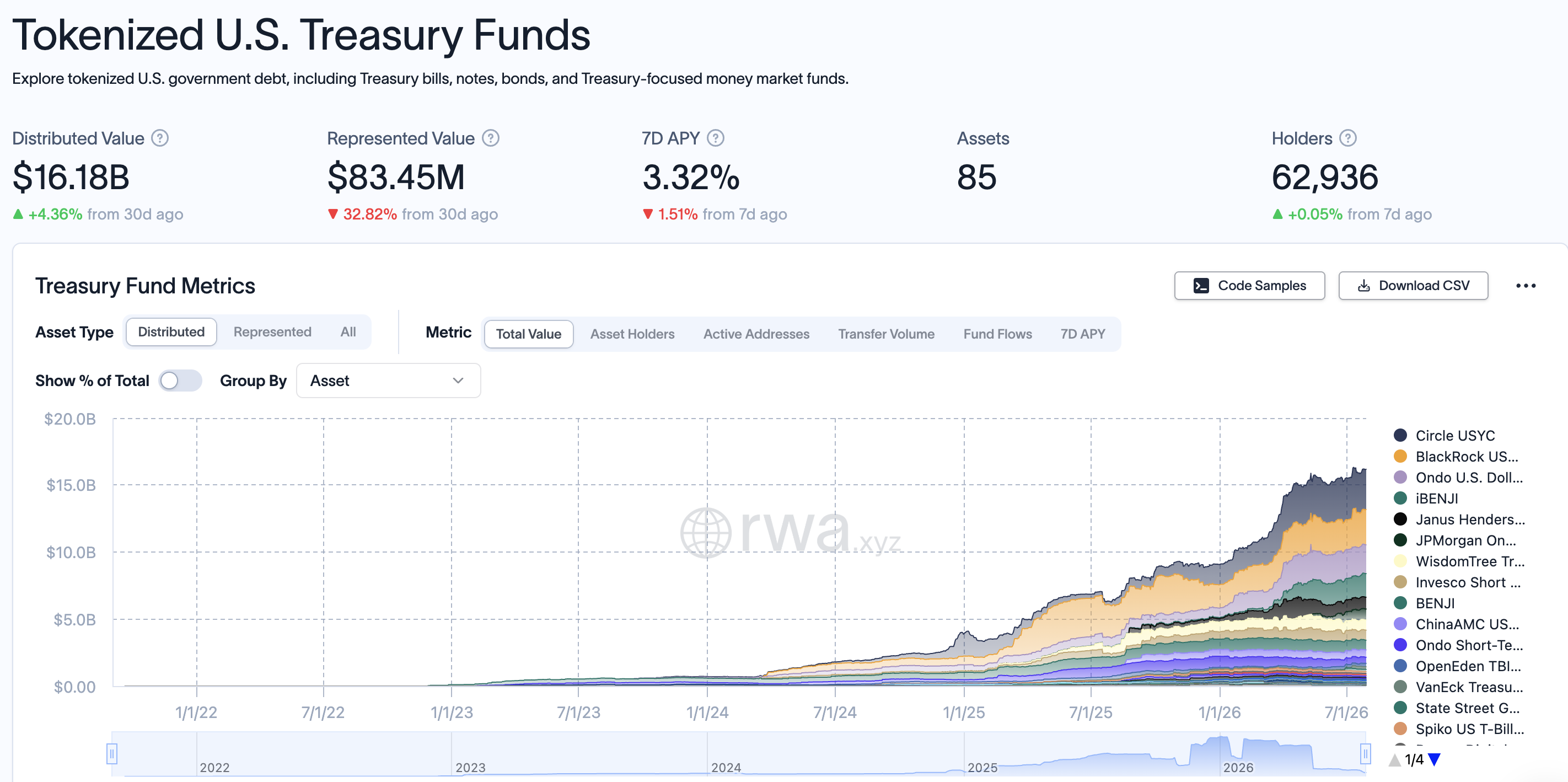
For Tokenized U.S Treasury Funds, Circle’s USYC is currently leading the market, sitting at $3B onchain. Following that is BlackRock’s BUIDL, sitting at $2.6B in assets, and Ondo’s U.S Dollar Yield comes in third with $2.1B in assets.
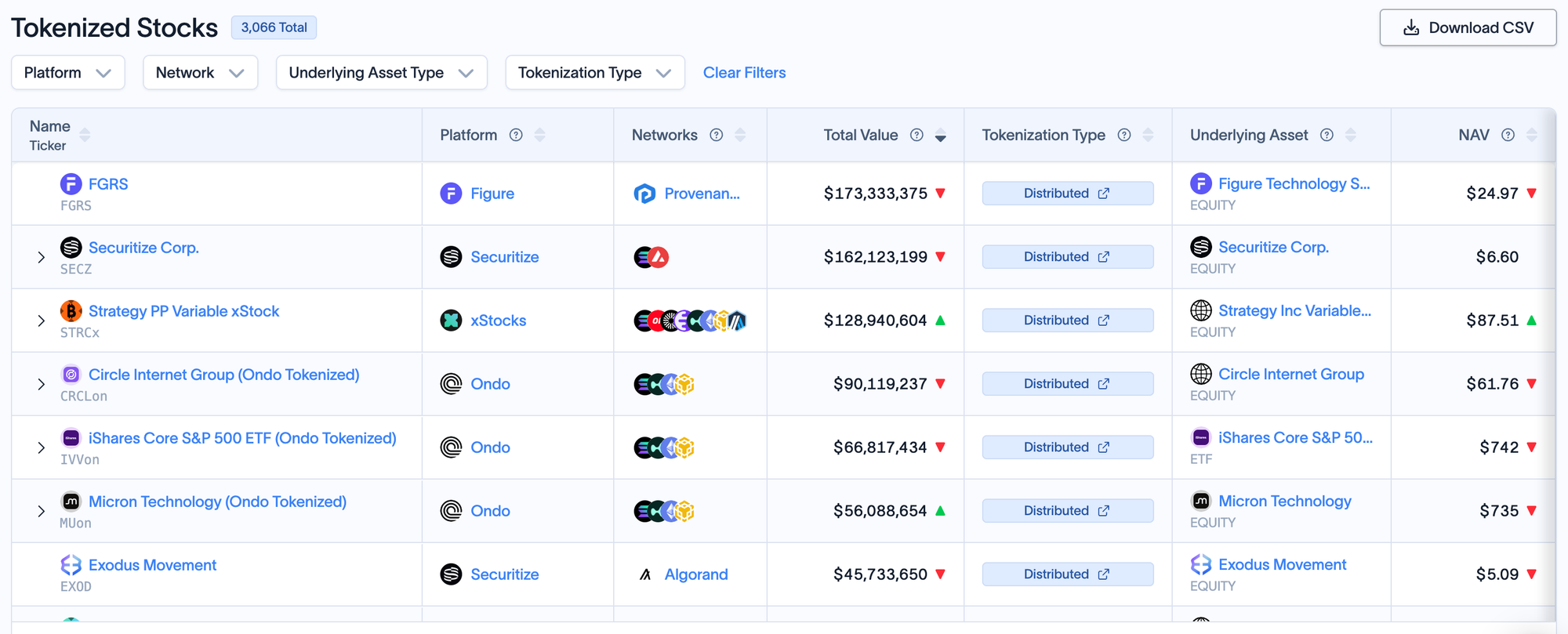
Tokenized stocks are also growing rapidly, with total distributed value reaching $1.9 billion, up 24.7% over the past 30 days. Led by Ondo, alongside platforms such as xStocks and Securitize, the sector is bringing publicly traded equities onchain and making them more accessible through blockchain-based markets.
Tokenized private credit remains one of the largest real-world asset categories, with Figure Technology continuing to lead the market by value.
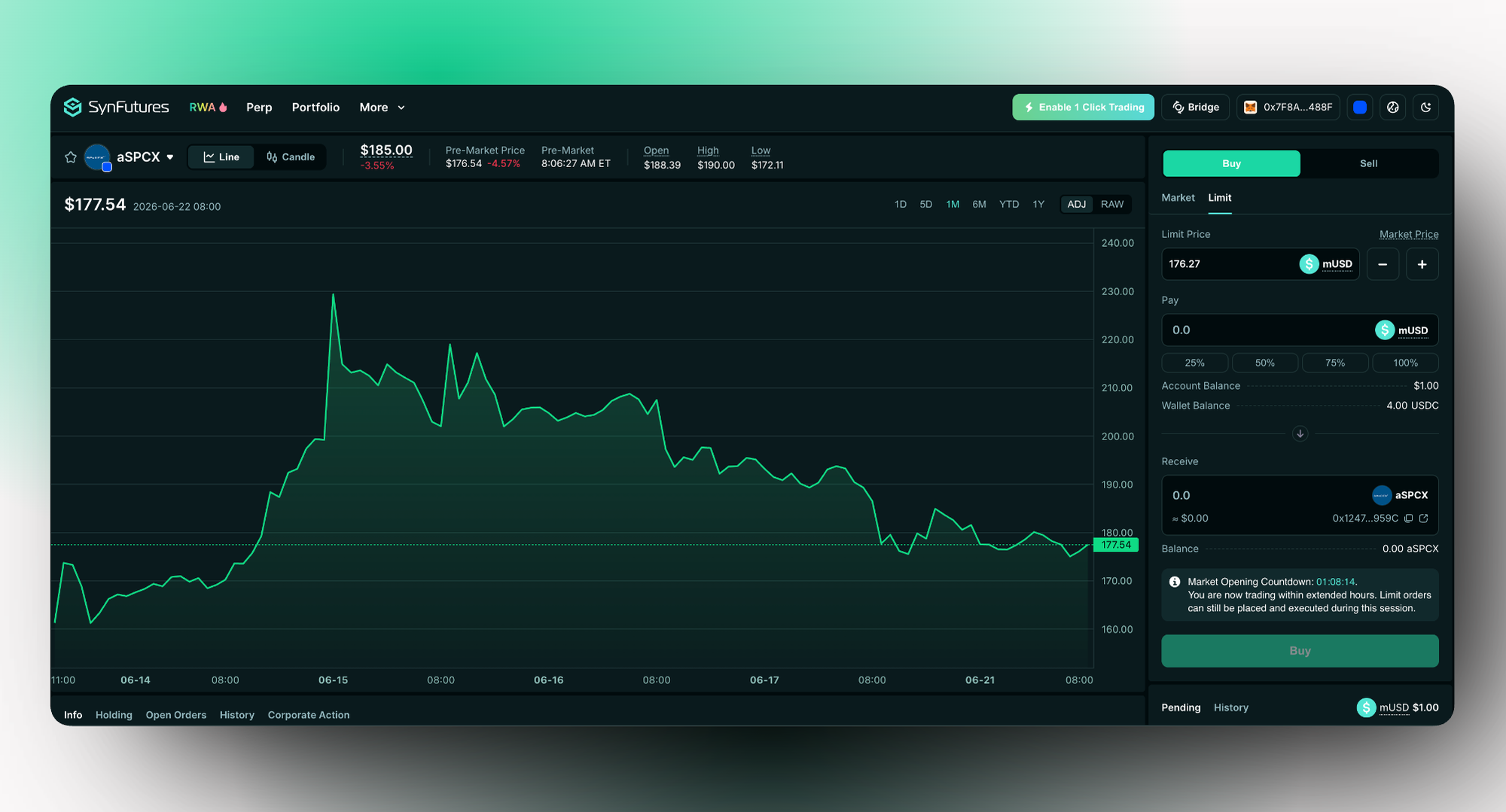
SynFutures’ latest announcement and product release in June brought some of the biggest US names onchain — enabling investors from around the world to get a fraction of U.S stock. Names such as NVIDIA, Meta, Tesla, and Google were launched on day one, becoming tradable on the Base network.
Following the launch of tokenized stocks, SynFutures, powered by Anchored, brought SpaceX onchain on the very first day it began trading on Nasdaq, giving users seamless access to one of the most anticipated IPOs in history.
The Blockchains Taking Charge of the RWA Race
As tokenization continues to accelerate predominantly on Ethereum, other blockchains are becoming the infrastructure powering the next generation of financial markets.
Rather than competing to replace traditional finance, leading networks are focused on providing the speed, security, and scalability needed to bring Real World assets onchain.
Many of the largest tokenized funds and financial products, including those from BlackRock, Franklin Templeton, and Securitize, have been launched on Ethereum or Ethereum-compatible infrastructure.
BNB Chain (Binance Chain) ranks second, with $5.2B in onchain assets, and continues to grow exponentially within the ecosystem.
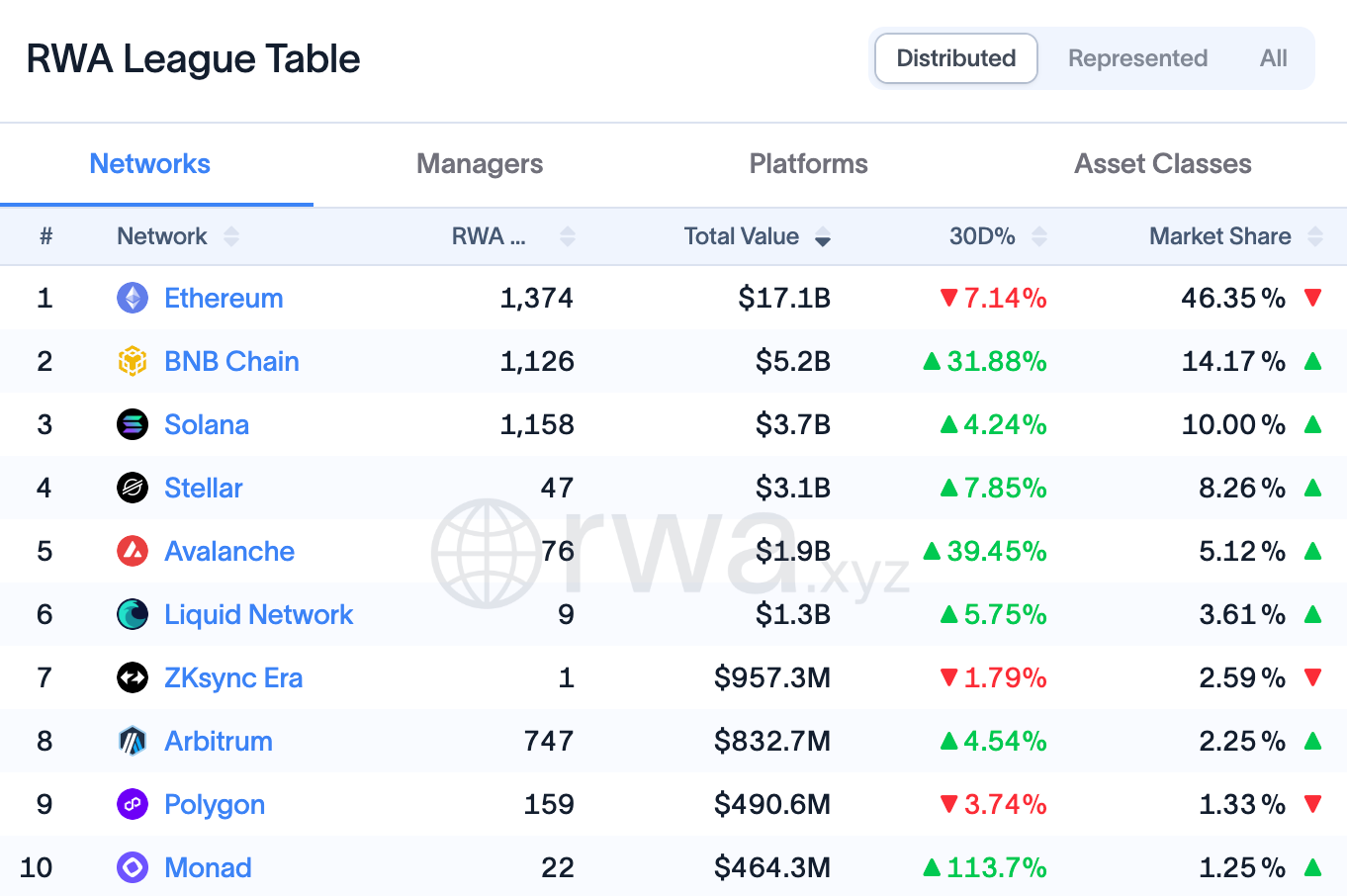
Other ecosystems in the top 10 include Solana, Stellar, Avalanche, Liquid Network, and more.
Just recently, the Monad ecosystem entered the top 10 blockchains, leading the RWA league.
While no single blockchain has won the race, one thing is becoming increasingly clear: the future of tokenized finance will be built across multiple interoperable networks.
As more institutions and developers enter the space, the focus is shifting from which blockchain will dominate to which can best support the next generation of global capital markets.
The Move to Onchain
So, the question comes down to why is everything moving onchain?
By representing Real World Assets as digital tokens on the blockchain, ownership can be verified instantly, transactions can settle faster, and access is no longer limited by geography or traditional market hours. What began with stablecoins has now expanded into a much broader transformation of global finance.
Today, almost every major asset class is being explored for tokenization.
Real estate can be divided into smaller ownership stakes, opening the door to fractional investing. Private credit and bonds can be issued and managed more efficiently, with faster settlement and greater transparency for investors.
Other experiments now also include artificial intelligence. From decentralized GPU networks and compute marketplaces to tokenized data sets and AI agents that can transact onchain.
 Colin Basco - Research AssociateDavid Duong, CFA - Global Head of Research
We are also beginning to see tokenization applied to intellectual property, music royalties, carbon credits, supply chains, luxury goods, and digital identity.
The move onchain is no longer limited to crypto native assets. It is becoming the foundation for how value is created, exchanged, and owned across industries.
As technology matures and adoption continues to accelerate, the question is no longer if assets will move onchain, but what will be next.
About SynFutures
SynFutures is a decentralized perpetual futures protocol that facilitates open and transparent trading on any assets and listings instantly.
The V3 Oyster AMM launched the industry’s first-ever unified AMM and Permissionless Onchain Orderbook. Backed by top investors like Pantera, Polychain, Standard Crypto, Hashkey, and more, SynFutures has processed more than $100 billion in trading volume since its launch in 2021.
Learn more: